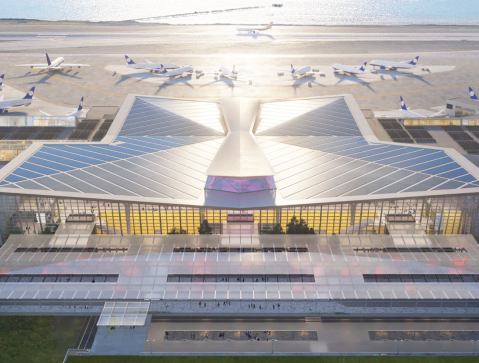
JFK Terminal One:
Connecting Capital to Opportunity
As a global center of finance, commerce, culture, art, and fashion, New York City has always been an international gateway, a place where people arrive seeking opportunity. But in recent decades, John F. Kennedy International Airport (JFK), one of the busiest airports in the United States, has struggled with outdated terminals, limited gate capacity, and inefficient layouts. The result strains both passengers and airlines, leading to increased flight delays, cancellations, and higher operating costs.
JFK is not alone in these challenges but has become a symbol of what happens when infrastructure struggles to keep up with a changing world. Airports across the US are expected to need over $170 billion in investment over the next five years1, but public funding continues to be stretched thin. In the case of New Terminal One (NTO) at JFK, few private investors had the experience and resources to undertake a development of this scale and complexity.
Reimagining a Global Gateway
Where others saw complexity, Carlyle saw potential. Drawing on our experience with infrastructure, we brought together the right financial and operational expertise needed for a project of this magnitude. In addition, our history of successful public-private partnerships gave us a clear understanding of how to align public goals with private capital.
The New Terminal One is a central part of the Port Authority of New York & New Jersey’s (Port Authority) $19 billion transformation of JFK, with two new terminals, major upgrades to two others, and a completely rebuilt roadway network. In 2018, the Port Authority selected Carlyle to lead the consortium of partners developing NTO, given our capabilities, commitment, and a vision that demonstrated a strong New York sense of place and offered a seamless passenger experience. With $9.5 billion in private investment2, it is the largest airport redevelopment of its kind in US history.
Beyond dollars, this project is about creating a lasting impact. It transforms an airport terminal into a world-class destination, delivering a passenger experience imbued with future-focused technology, all done in partnership with the surrounding communities to create jobs and business opportunities.
A Terminal Built by and for New Yorkers
Carlyle engaged local stakeholders early in the process, recognizing that alignment with the community reduces risks, accelerates execution, and fosters a sense of shared ownership that makes the project and the community stronger.
Working with the Port Authority, city and state officials, and our consortium partners, Carlyle prioritized local hiring, Minority- and Women-Owned Business Enterprises (MWBEs), and labor participation. We didn’t just want the people and businesses of Queens to witness the transformation; we wanted them to help drive it. So, we listened carefully and collaborated with stakeholders to ensure the project reflected shared priorities.
The result: more than 10,000 jobs created, including over 6,000 union positions, and more than $1.5 billion in MWBE participation.3


Collaboration at Scale
The challenges of large-scale infrastructure investments aren’t for everyone. Beyond the cranes, Carlyle offered an integrated organization ensuring progress behind the scenes. Drawing on our teams across infrastructure, capital markets, government affairs, aviation, and real estate, our insightful perspective helped us navigate regulatory complexity and pivot in response to broader market shifts.
The pandemic tested the project early in 2020. When travel demand collapsed, Carlyle negotiated a restructuring of project terms to reflect the industry’s new realities, enabling the project to move forward.
Credit markets then dislocated in 2022, creating another hurdle. Carlyle Capital Markets helped arrange financing that, combined with our banking relationships and credibility, allowed the project to secure more than $6.5 billion in bank financing, despite a challenging environment.
Later that year, Carlyle sold a partial stake to Ferrovial, helping us reduce risk and return capital to our investors, while also bringing in additional construction and project management expertise. This approach still enabled Carlyle to remain actively involved in guiding the project’s long-term value creation.
These disruptions underscore the importance of flexibility and clear communication with stakeholders. We not only kept the project on track, but were able to manage risk effectively, protect investor value, and lay the foundation for a resilient, next-generation terminal.
Future-Ready and Built to Last
Phase one is scheduled to open in 2026, with full completion expected in 2030. JFK’s New Terminal One will encompass 2.4 million square feet, featuring 23 gates and over 300,000 square feet of retail, dining, and lounge space.
Designed with sustainability in mind, the terminal will feature a rooftop solar array with over 13,000 panels to achieve its target of 50% of energy consumption through this onsite microgrid. The LEED-certified design incorporates energy-efficient systems that will reduce utility costs and a rainwater catchment system to minimize water consumption. These features are expected to lower long-term operating expenses, reduce downtime risk, and enhance long-term resiliency.
Delivering Impactful Results
When New Terminal One opens its doors, it will be more than an airport terminal. It will be New York’s new front door – innovative, sustainable, and designed for the next century, reflecting the energy and resilience of the city it serves.
This investment underscores what’s possible when we bring together the full strength of our platform to address complex, high-impact challenges. From navigating regulatory landscapes and balancing diverse interests to optimizing revenue streams and embedding sustainability, the project demonstrates how Carlyle works across sectors and interests to move beyond a transactional investment to help build infrastructure that serves communities and stands the test of time.
More importantly, it serves as an example of how we believe infrastructure projects should be executed. As one of the largest airport redevelopments of its kind in US history, New Terminal One’s significance goes beyond size. It’s a model for what private capital can achieve when deployed thoughtfully to help solve public challenges and create shared economic opportunity.