How Washington’s Institutions Took Shape
Welcome back to From David’s Desk, a newsletter penned by Carlyle Co-Founder and Co-Chairman David M. Rubenstein. Each edition provides insights on public policy, geopolitics, and other topics in and around Washington, DC. Discover past editions on the series' webpage.
In recent months, five of the US Government's largest cultural organizations have attracted considerable public attention, perhaps more than they have ever had, in part because of unexpected budget cuts, leadership changes, and differing perspectives on their focus.
Without getting into these differing perspectives, I thought it might be useful for those interested in Washington-related developments or culture to take an unvarnished look at these organizations, and how they differ in structure and purpose. I have had a relationship with each of them.
These are the five, in chronological order of their creation:
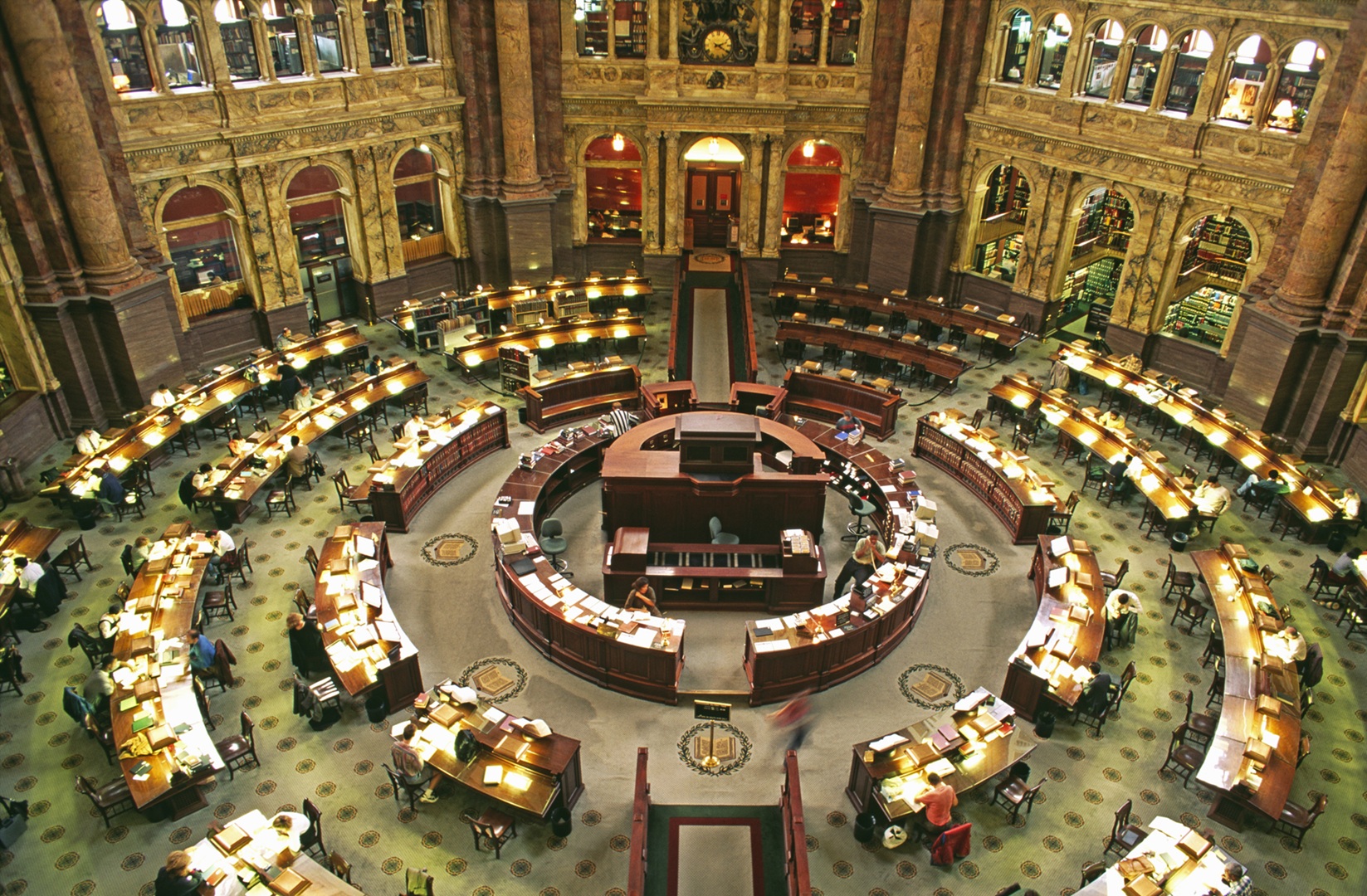
1. Library of Congress
A library to assist Congress in its work was first proposed by James Madison in 1783, during the Congress that operated under the Articles of Confederation. Nothing really happened in response. But when the Constitution was put into effect, the Congress in 1800 passed legislation, signed by President John Adams, which authorized the creation of the Library and appropriated $5,000 for that purpose. That sum was used to purchase more than 700 books and three maps. The Library was housed in the Capitol building and grew modestly in its early years. When the British invaded Washington and burned the Capitol in 1814, the Library’s entire collection was destroyed.
The destruction prompted the person with the largest private collection of books in the country, Thomas Jefferson, to offer to sell his collection to the Library. The Congress balked at first; Jefferson, a Deist, was believed to have works in his collection that might not be supportive of Christianity. So, each book was reviewed, the collection was ultimately deemed acceptable, and the 6,487 volumes in the collection were purchased for $24,000.
Jefferson’s library formed the core of the Library’s collection for many years, but a fire in the Capitol in 1851 destroyed two-thirds of it. The Library has since replaced most of the lost books with replicas from that era. In time, the Congress ultimately provided additional resources, more books were purchased, and the Library eventually outgrew the Capitol. In 1897, the Library moved into a new building – now called the Jefferson Building – across the street from the Capitol, on a site where there had once been apartments rented by Members of Congress, including Abraham Lincoln during his one term in the House of Representatives.
The Library is open to everyone, although only Members of Congress can check out items. In recent decades, it has become the largest library in the world, with more than 180 million books, maps, documents, and other items in its collections. The Library does buy books, particularly rare books like the Gutenberg Bible, but it also gets two copies of every book published in the United States if the author or publisher wants the books to be copyrighted. (The Office of Copyright is currently housed in the Library of Congress though an effort is now underway to have the Registrar of Copyrights be appointed by the President and to have the Office become part of the Commerce Department.)
The Library now also has a John Adams Building behind the Jefferson Building, and a Madison Building across the street from the main building, with buildings for audio-visual items on the Packard Campus in Culpeper, Virginia.
The Library is overseen by the Librarian of Congress. Historically a presidential lifetime appointment, the role was changed by Congress just before President Obama named Carla Hayden, then-head of the Enoch Pratt Free Library in Baltimore, as the fourteenth Librarian. The law now provides for a ten-year term, with the option of a single ten-year reappointment.
Carla Hayden broke several molds in becoming the Librarian of Congress: she was the first woman, the first African American, and the first professional librarian in over four decades to serve in that role.
President Trump removed her on May 8, 2025, eight and a half years into her ten-year term. Hayden was succeeded on an interim basis by Robert Newlen, a forty-seven-year veteran of the Library who had been serving as the Deputy Librarian after a recent stint as head of the Library's Congressional Research Service. President Trump is supposed to appoint a new Librarian of Congress in the near future, and that ten-year appointment will be subject to Congressional confirmation, although some Members of Congress are considering a legislative change to have the Librarian appointed by Congress.
The Library of Congress receives most of its funding from the federal government, but it also benefits from private support through the James Madison Council. Established in 1990 as the Library’s private-sector donor group, the Council was long chaired by John W. Kluge, whose generous $60 million gift in 2000 created the John W. Kluge Center at the Library. For the past decade, I have had the privilege of serving as Chair of the James Madison Council.
2. The Smithsonian Institution
James Smithson, a British scientist and illegitimate son of a British Lord, died in 1829 and left most of his entire estate to his nephew, provided the nephew produced heirs. When that nephew died without heirs, Smithson’s estate was designated to fund an institution in the United States, a country he had never visited, “under the name of the Smithsonian Institution, an establishment for the increase and diffusion of knowledge among men.”
With memories of British Troops burning Washington in the War of 1812 fresh in mind, there was some skepticism within Congress about this gift – a potential Trojan Horse some argued. But after much debate, Congress agreed to accept the funds in 1836 and sent prominent American diplomat Richard Rush to London to retrieve the gift, which turned out to be about half a million dollars in gold coins (worth more than $200 million today). The coins were brought to Philadelphia, but Congress was uncertain how to proceed, since the details of the new institution were far from settled. During eight years of deliberation over how to use Smithson’s bequest, Congress invested the funds in Arkansas state bonds. Unfortunately, those bonds defaulted and the original endowment was wiped out.
Congress then spent several years debating whether the funds should be replenished by the government. Ultimately, based on the argument of a highly respected member of Congress, John Qunicy Adams, who had earlier served as President of the United States, the money was restored with interest, and in 1846 President Polk signed legislation creating the Smithsonian Institution, to be run by a Board of Regents and a Secretary.
In 1855, the Smithsonian’s first building, designed by James Renwick (who also designed St. Patrick’s Cathedral in New York) opened on the Mall in Washington. Its first director, physicist/inventor and Princeton professor Dr. Joseph Henry, lived with his family in the building, alongside many of the Smithsonian’s artifacts. The building, the first on the Mall, was known as The Castle because of its architectural style and resemblance to a European grand fortress. The Castle’s tower was the highest point in Washington, and Lincoln apparently went to the tower several times to see where Confederate troops in Virginia were positioned.
Today, the Smithsonian consists of twenty-one museums, with two more in the process of being built: the Women’s History Museum and the Museum of the American Latino. It also includes nine research centers and the National Zoo, where two popular panda bears now reside. The Smithsonian’s museums are free to the public thanks to congressional support; about two-thirds of its budget comes from the federal government, while roughly one-third is funded through philanthropy.
Of the Museums, the recently reconstructed Air and Space Museum (with its sister museum at Dulles Airport, the Udvar-Hazy Center) is the most popular, with more than eight million visitors a year before its partial closure for reconstruction, which began in 2018. The second most popular is the Natural History Museum, with more than four million visitors a year. The most recently created Museum, the African American History and Cultural Museum, opened in 2016 and has about three million visitors a year.
The Smithsonian’s governing structure has evolved over the years, but it currently consists of a Chancellor (who is the Chief Justice), the Vice President of the United States, six Regents who are Members of Congress (with the majority party in each chamber appointing two of the three Congressional regents), and nine citizen Regents, one of whom must be from the District of Columbia. The citizen Regents are designated by the existing Regents board but must be approved by the Senate and the House. I chaired this board for four years; the current chair is Dr. Risa Lavizzo-Mourey, former chair of the Robert Wood Johnson Foundation.
On a day-to-day basis, the Smithsonian is run by a Secretary, with the fourteenth and current officeholder being Lonnie Bunch, a historian and museum administrator who previously built and led the National Museum of African American History and Culture. He serves at the pleasure of the Regents.
3. The National Archives
When the government of the United States was created under the Constitution, each Cabinet department or government agency kept its own records. There was no central recordkeeping place. That was somewhat inefficient for those who wanted to know about or retrieve government documents. But just as important, many of these departments did not take documentation seriously, and records were kept sloppily and in places not protected against weather-related damage or fires, which were common in the wood structures often used to house government documents.
So, it was proposed in the mid 1800's that having a central repository would be a better way to collect, store, and retrieve government documents. Congress did not actually get around to creating such a place, the National Archives, until 1926. The Archives building, initially designed by John Russell Pope and built from 1931 to 1937, opened on a large two-block site adjoining the National Mall.
The National Archives was created by Congress as a place to hold all official records and documents of the U.S. government, from its creation to the present. Now, all digital records are also part of the Archives mandate.
Today, the Archives houses the original (and very faded) copies of the Declaration of Independence, the Constitution, and the Bill of Rights. It also houses the only copy in the United States of the Magna Carta, which I have lent to the Archives.
The Archives today houses more than 13.5 billion physical papers and documents, and 33 billion digital records. Most of the money to operate the Archives comes from the Federal government, though the National Archives Foundation does provide some philanthropic support.
Welcoming more than two million visitors a year, the Archives is led by the Archivist of the United States, who is appointed by the President. Most recently, that Archivist was Dr. Colleen Shogan, a historian, who was appointed by President Biden and removed by President Trump early in his second term. The Acting Archivist is Secretary of State Marco Rubio, but James Byron, previously the Executive Director of the Nixon Presidential Library, has been appointed to run the Archives on a day-to-day basis.
In addition to collecting and preserving the documents of the United States, the Archives operates the nation’s system of Presidential Libraries. There are currently 13 official Presidential Libraries operated by the National Archives, with three more on the way: President Obama’s in Chicago, President Biden’s in Delaware (specific site to be determined), and President Trump’s, for which a location in Miami has reportedly been selected.
Because of digitization, the newest Presidential Libraries will not house a President’s physical papers. The soon-to-open Obama Presidential Center will be the first to follow this model.
4. National Gallery of Art
The National Gallery was created by Congress in response to a gift proposal from Andrew Mellon, former Secretary of the Treasury. He proposed to gift to the United States the bulk of his world-class art collection and promised to fund a neo-classical building needed to house his collection and those of others if Congress would designate the institution as the National Gallery of Art and allow it to operate with a five-person, self-perpetuating board of trustees. Congress agreed to do so in legislation passed in 1937. I currently serve as Chairman of this board; Darren Walker, the immediate past President of the Ford Foundation, serves as President of the Gallery.
The director of the Gallery is Kaywin Feldman, an experienced art museum administrator who assumed her current position in 2019 following her tenure as director of the Minneapolis Institute of Art.
In 1978, the National Gallery received a gift from Andrew Mellon’s children, Paul and Ailsa, to fund construction of the East Building. Designed by I. M. Pei and dedicated primarily to twentieth- and twenty-first-century art, the East Building complements the original West Building, which was designed by John Russell Pope and focuses on earlier works. There is also an outdoor Sculpture Garden.
When Congress agreed to Andrew Mellon’s request, the principal art museum that was part of the Smithsonian already had the same title, and that museum’s name was then changed, eventually becoming what is now known as the Smithsonian American Art Museum.
The legislation creating the National Gallery obligated Congress to provide annual funding for its operation but did not provide money for art acquisitions. Today, the museum relies almost entirely on Congressional funding for its operating expenses, while all art acquisitions are supported through private donations.
The Gallery has more than 160,000 works of art and artifacts, including the only Leonardo da Vinci painting in the United States, Ginevra de’ Benci.
The National Gallery has about four million visitors per year.
5. The Kennedy Center
When the District of Columbia was conceived as the nation’s capital, George Washington envisioned a city that would rival great capitals like Paris and London, complete with a vibrant cultural life. He believed a truly distinguished national capital should include major cultural institutions alongside government buildings. However, money was scarce, and Pierre L’Enfant, the city’s original designer, had to abandon plans for such a cultural center. Eventually, Washington dismissed L’Enfant, and the government focused on constructing the Capitol and the President’s House, further abandoning the idea of creating a cultural center.
During the nineteenth century, to meet the interest of citizens for live performances, entrepreneurs built theaters in the nation's capital. The most famous of these was John T. Ford’s eponymous theater where President Lincoln was assassinated.
During the twentieth century, there was much discussion about reviving the idea of creating a cultural center in Washington, but the idea did not attract enough support in Congress until 1958, when it authorized a National Cultural Center. President Eisenhower signed the legislation and was fully supportive of the Center’s creation, although no money was appropriated for the purpose by Congress; the money was to be raised from private sources. Very little was actually raised.
When President Kennedy took office, he sought to re-energize the fundraising effort by appointing Roger Stevens, a real estate developer and Broadway producer, to lead the campaign. National telethons were held, some led by Leonard Bernstein, including one in which seven-year-old cellist Yo Yo Ma performed. More money was raised than had been the case under President Eisenhower, but the US government was still not providing a meaningful level of funds, and the total remained insufficient to build a center.
When President Kennedy was assassinated in November 1963, his family wanted to create a living memorial to honor him and supported the idea of renaming the not-yet-built National Cultural Center as the John F. Kennedy Center for the Performing Arts. Congress passed legislation in early 1964 authorizing the name change, and plans began in earnest to build the Center with both private and governmental support. Ultimately, the Center opened in 1971. The cost was on the order of $70 million, with roughly half provided by the government and the other half by donations from private individuals and some foreign governments. The architect was Edward Durell Stone, chosen in part because Mrs. Kennedy admired his work on the US Embassy in New Delhi, India.
The costs of maintaining the Kennedy Center building are borne by the US government. The cost of providing cultural programs – in classical and popular music, dance, opera, and theater – is borne by the Center itself, with about half of those costs supported by ticket sales and about half by philanthropy. Overall, roughly 20 percent of the Kennedy Center’s annual expenditures comes from federal appropriations.
The Center has three main performance venues – the Opera House, the Concert Hall, and the Eisenhower Theatre. An additional facility, opened in 2019 and known as the REACH, is funded solely by private contributions and used for rehearsals, education, meetings, and some performances.
The National Symphony Orchestra, created in 1931, became a part of the Kennedy Center in 1986. The Washington National Opera performs at the Kennedy Center and receives some financial support from it but remains an independent organization.
Initially, the Center was under the control of the Interior Department, but later legislation made the Center an independent organization. Currently, the Center is overseen by a board of thirty-six trustees, appointed for six-year terms by the president, plus two dozen ex-officio members who hold senior positions in the executive and legislative branches. I served as chair of the board for fourteen years and have been succeeded by President Trump, who became the first US president to also serve as chairman of the Kennedy Center board. All the Center’s current board members have been appointed by President Trump. The current president of the Center is Ric Grenell, who succeeded Deborah Rutter; she had served eleven years in that role.
The Kennedy Center holds many events during the year – on the order of two thousand performances annually – with a free performance offered nearly every night. In a typical year, about two million people visit the Kennedy Center for performances and programs.
The Kennedy Center Honors program, held in December of each year, is televised nationally. This year, the honorees are Michael Crawford, Gloria Gaynor, KISS, Sylvester Stallone, and George Strait.
What these institutions have most in common is the quiet but essential role they play in helping people encounter, understand, and appreciate the many strands of our national story. They are places where anyone can read an original document, study a painting, watch a performance, or simply wander and learn something new. My hope is that, in the years ahead, these institutions will continue to give visitors the same opportunity they have given me: a better understanding of our country and the many ideas and talents that have contributed to its story.